
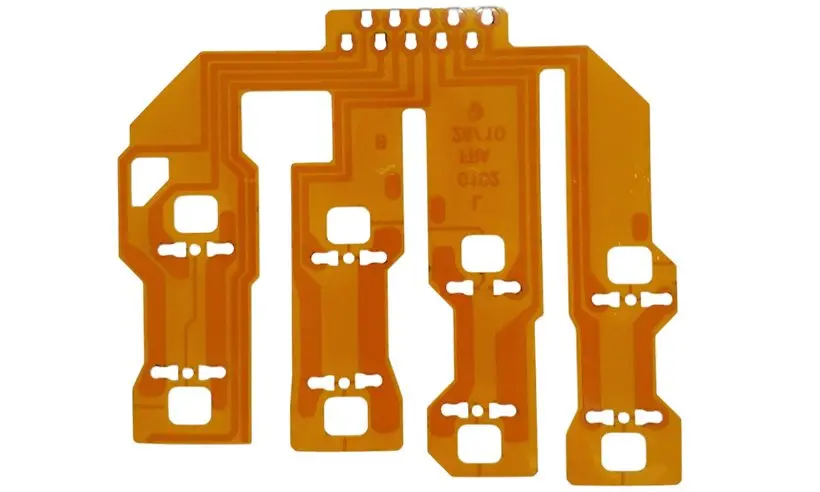
Start with the construction definition
Material selection establishes the copper, dielectric and bonding system that the process must accommodate. The materials guide distinguishes laminate, coverlay and reinforcement roles. Agree grade and construction before interpreting a process description as evidence for the finished thickness or electrical properties.
A process review tied to outputs
| Operation group | Design definition | Review question |
|---|---|---|
| Circuit formation | Copper patterns and interconnects | Does the process match the intended stack? |
| Insulation and reinforcement | Openings and local support | Which registrations control usability? |
| Finishing and profiling | Contacts, outline and datums | How is finished acceptance checked? |
Connect each operation to a design feature
Conductor patterning defines the circuit geometry; plated interconnections, where specified, connect layers. Protective coverings leave intentional openings for contacts and joining. Reinforcement and outline formation create local mechanical interfaces. Some features change the order or number of operations, which is why a regional stackup drawing belongs in the review.
Ask how the proposed process preserves critical relationships: coverlay to pads, stiffener to contact tail, and outline to mechanical datums. Avoid assuming that nominal CAD coincidence means zero manufacturing variation. Provide functional tolerances that can be measured on the completed circuit.
Place verification at meaningful checkpoints
Discuss what is inspected before features become hidden and what is checked on the finished circuit. Electrical test, dimension checks and construction records provide different evidence. Request acceptance requirements appropriate to the product, with the applicable document revision where contracted. A list of manufacturing operations by itself proves neither process qualification nor a particular factory capability.
Before you release the design
- Review the actual proposed construction before the process route.
- Flag dimensions that span multiple operations.
- Ask how hidden construction features are verified.
- Tie inspection records to the released revision.
Watch points
- A generic process diagram cannot establish the tolerance, yield, capacity or qualification of a particular supplier.
Practical questions
Does every flex circuit follow the same route?
No. Layer count, plated features, bonding, reinforcement and assembly change the required operations. Review the specific construction with the manufacturing recipient.
Can a process change affect an approved design?
It can. Assess the affected materials, dimensions and performance evidence through change control rather than assuming every route produces an equivalent article.
Technical references
References support the material or design context. Check the exact grade, part number, document revision and project conditions before release.For an additional process overview, see this flexible circuit manufacturing reference ↗.
Updated 27 September 2026 · Technical content policy · Engineering guidance supports project review; the agreed drawing defines the build.