
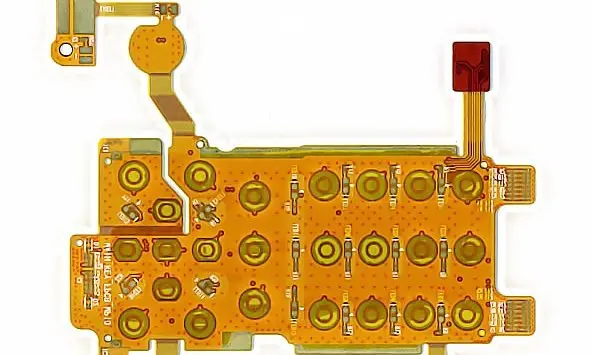
Model the ribbon through the complete hinge path
Capture open, closed and intermediate states, including where the circuit contacts guides or neighboring parts. Record how the attachment points move and whether the ribbon slides, rolls or twists. The dynamic-flex guide helps translate hinge travel into a circuit-level motion specification.
Foldable-device motion brief
| Input | Required detail | Purpose |
|---|---|---|
| Hinge path | Mounts, intermediate states and contact | Reproduce circuit motion |
| Local stack | Every moving-region constituent | Control tested construction |
| Test plan | Cycles, conditions and detection | Generate relevant endurance evidence |
Control construction in the moving zone
Identify every layer present in the hinge region, including copper references, coverlay, adhesives and shielding. Use the thickness worksheet to document the nominal local construction. It is a bookkeeping aid, not a fatigue-life predictor.
Place connector and reinforcement transitions within the complete route review. A thin central ribbon can still experience a concentrated load where support ends. If separated layers or selective bonding are proposed, specify their boundaries and termination details rather than treating the construction name as sufficient.
Test wear and electrical behavior together
Build the motion test with representative guides, mounts and clearances. Define cycle requirement, rate, environment, interruption detection and failure criteria with the product owner. Inspect rubbing and displaced layers as well as continuity. Review any accelerated conditions against the intended mechanism, and keep the tested construction tied to the released material and process definition.
Before you release the design
- Provide intermediate positions, not only open and closed views.
- Identify sliding contact and wear surfaces.
- Freeze the moving-region stack and support transitions.
- Agree test conditions and intermittent-fault detection.
Watch points
- Testing an unconstrained ribbon loop can miss the rubbing and compression imposed by the actual hinge.
Practical questions
Can bend radius predict fold life?
Not by itself. Construction, routing, supports, contact, environment and test conditions all matter. Use radius as one defined geometry input in a representative evaluation.
Should the thinnest stack always be chosen?
Balance thickness against routing, references, handling and interfaces. A nominally thinner option still needs construction review and representative motion verification.
Technical references
References support the material or design context. Check the exact grade, part number, document revision and project conditions before release.Updated 27 September 2026 · Technical content policy · Engineering guidance supports project review; the agreed drawing defines the build.