
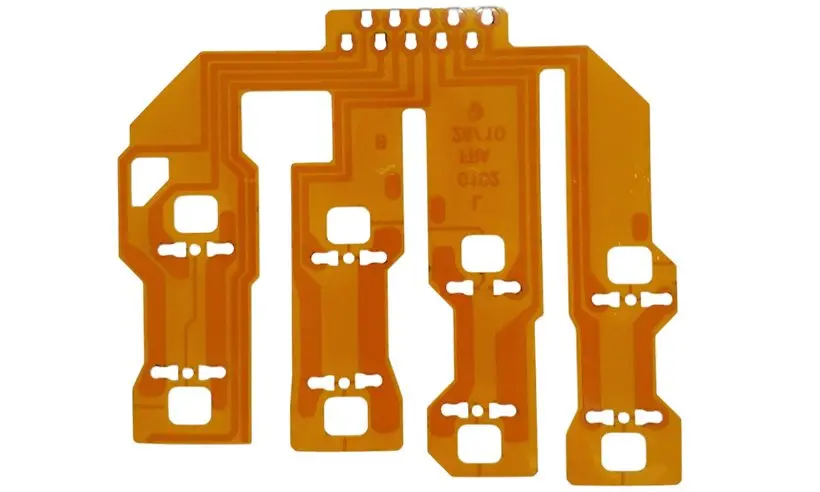
Separate solder joints from mating contacts
Mark which exposed conductors are soldered and which remain as contacts. Repeated connector mating and one-time solder assembly impose different requirements. Read the exact connector drawing alongside the contact-finger guide; do not select a contact finish from a generic flex recommendation.
Finish selection starts at the interface
| Interface | Input needed | Acceptance discussion |
|---|---|---|
| Soldered pads | Assembly process and component requirements | Joining quality and surface condition |
| Mating contacts | Exact connector specification | Contact finish and dimensional compatibility |
| Special connection | Defined joining method | Qualified process and inspection evidence |
Coordinate finish with the local construction
Identify masked areas, coverlay openings and the surfaces requiring finish. The coverlay opening plan should remain compatible with solderable areas and contact clearance. Include any finish contribution that matters to a tightly controlled terminal thickness.
If different finishes are proposed in different regions, ask how they are achieved, inspected and priced. Avoid assuming every combination is available or economical. Request documented compatibility with the chosen joining process and customer requirements; an attractive finish description is not evidence of interface qualification.
Define handling and acceptance conditions
Agree the expected storage, packaging and assembly sequence with the manufacturing recipient. Specify the relevant inspection or test and acceptance document where applicable. When comparing quotes, check whether the same surfaces, finish requirements and verification are included. Keep any substitution subject to review because it can change assembly behavior or contact performance.
Before you release the design
- Identify the function of every exposed copper region.
- Reference the exact connector or joining specification.
- State required finish locations and verification.
- Review packaging, storage and substitution assumptions.
Watch points
- The same nominal finish category can hide different requirements for contacts, solder joints and special connections.
Practical questions
Is one surface finish best for every flex circuit?
No. Choose against the intended interface, assembly process and acceptance requirements. Confirm project-specific process availability with the recipient of the inquiry.
Can a finish change be accepted to shorten the schedule?
Only after checking affected soldering, contact, thickness and qualification requirements. Document the approved change and any verification it needs.
Technical references
References support the material or design context. Check the exact grade, part number, document revision and project conditions before release.Updated 27 September 2026 · Technical content policy · Engineering guidance supports project review; the agreed drawing defines the build.